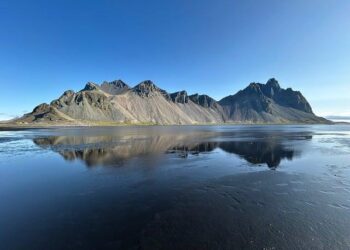
Former President Donald Trump has once again sparked controversy with his remarks, this time drawing attention for apparently confusing two distinct North Atlantic territories: Iceland and Greenland. During a recent interview, Trump’s comments blurred the lines between the island nations, raising questions about his geographical knowledge and prompting reactions from officials and analysts alike. The incident, reported by The Wall Street Journal, underscores the challenges public figures face when addressing complex international subjects and highlights the broader implications of such mix-ups in diplomatic discourse.
Trump’s Geographic Mix-Up Raises Questions About Policy Understanding
During a recent public appearance, former President Donald Trump mistakenly referred to Iceland when discussing Greenland, a geographical error that swiftly drew attention from political analysts and social media users alike. This slip has amplified concerns about whether key decision-makers fully grasp the territories involved in some of the administration’s most high-profile policy discussions. The confusion is particularly striking given Greenland’s strategic importance in Arctic geopolitics and natural resources, contrasting sharply with Iceland’s established role as a NATO ally and North Atlantic island nation.
Key distinctions between Iceland and Greenland highlight the potential implications of such misunderstandings:
- Iceland: An independent country in the North Atlantic known for its geothermal energy and strong international alliances.
- Greenland: An autonomous Danish territory rich in minerals and ice-covered land, currently a focus of U.S. strategic interest.
| Aspect | Iceland | Greenland |
|---|---|---|
| Political Status | Independent Republic | Autonomous Danish Territory |
| Population | ~370,000 | ~56,000 |
| Climate | Temperate Subarctic | Arctic |
Implications of Confusing Iceland and Greenland for US Strategic Interests
The mix-up between Iceland and Greenland, while seemingly a minor geographical oversight, raises significant concerns about the precision needed in U.S. strategic planning and diplomacy. Both territories hold distinct geopolitical importance in the Arctic region, with Iceland serving as a crucial NATO ally and airbase location, and Greenland offering vast natural resources and strategic positioning amid increasing Arctic militarization. Confusing the two could result in misaligned policies or diplomatic faux pas, undermining American influence and complicating existing partnerships in a region increasingly contested by Russia and China.
This error illuminates potential gaps in understanding that may affect:
- Military coordination and intelligence sharing between the U.S. and its NATO allies.
- Negotiations around resource extraction rights and environmental policies in Greenland’s Arctic territories.
- Long-term strategic investments in Arctic infrastructure development.
Failure to clearly differentiate these entities in public discourse could lead to confused messaging abroad, weakening Washington’s negotiating position and inviting criticism from international observers. The following table summarizes their contrasting roles in U.S. strategic calculations:
| Territory | Geopolitical Role | Strategic Assets |
|---|---|---|
| Iceland | NATO base hub and air defense gateway | Reykjavik Air Base, NATO radar installations |
| Greenland | Resource-rich land, Arctic military expansion focus | Thule Air Base, mineral and rare earth deposits |
Experts Recommend Enhanced Briefing Protocols for Presidential Geopolitical Awareness
Senior analysts and geopolitical experts are urging administrations to adopt more rigorous and standardized briefing protocols to prevent crucial misunderstandings at the highest levels of government. The recent incident, where a prominent political figure conflated Iceland with Greenland during a public interview, has intensified calls for enhanced clarity and precision in national security briefings. Experts argue that improved methodology, including multi-source verification and real-time geography refreshers, should become integral to executive intelligence sessions.
Proposed improvements from specialists include:
- Interactive mapping tools integrated into briefing packages for dynamic spatial orientation
- Regular refresher courses on global geography tailored specifically for policymakers
- Collaborative scenario planning involving foreign policy advisors and regional experts
- Enhanced checklists emphasizing geopolitical distinctions and current strategic interests
| Briefing Element | Current Practice | Suggested Enhancement | |||||||||||||||||
|---|---|---|---|---|---|---|---|---|---|---|---|---|---|---|---|---|---|---|---|
| Geographic Accuracy | Static maps in print | Digital, interactive maps with up-to-date data | |||||||||||||||||
| Briefing Frequency | Weekly updates | Daily micro-briefings for key geopolitical changes | |||||||||||||||||
| Expert Participation |
|